
Porch Lights & Algorithms

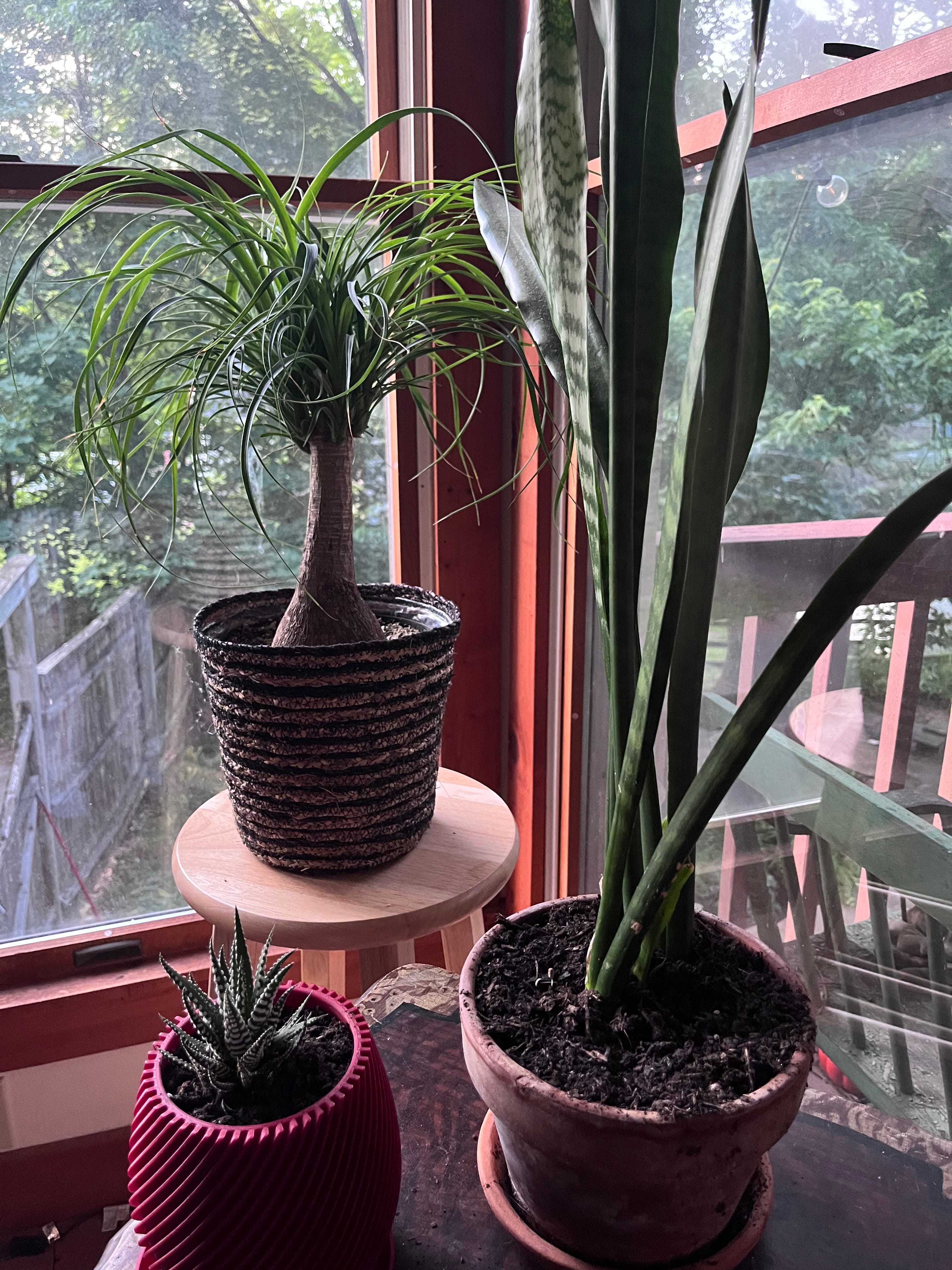
I’m becoming a plant person, and this is occurring nearly against my will. Not that I don’t want to be a plant person, but because it hasn’t seemed in their best interests that I try. Nevertheless, it appears they’ve set out to convince me otherwise —— such brave, brave plants, quietly risking their lives while they charm me with their greenery and growth.
Recently my niece, who is some sort of plant goddess, came over and helped me separate and repot a snake plant, and now two of the repotted plants are growing new shoots! This may not seem noteworthy, but I’m on paragraph two about plants, and I’m here to convince you otherwise.
My instagram algorithm has been working overtime the last six weeks to show me an endless supply of animals giving birth: horses, cats, cows, sheep, giraffes, and elephants. Wow. I have no idea what got this started, but how could I possibly have looked away? Somehow, watching a horse surrender to the process of birth gave me a lot more compassion for the feats my own body once performed, but also an appreciation for the effort and pain involved in birthing anything —— an idea, a poem, a song, a painting, my very own life.
And then a lovely friend sent me a link to a podcast interview with Pema Chödrön and something clicked. Pema talked about “collaborating with reality,” and that got me, because, like anyone who has found themselves caught up in codependency, I’ve spent a disproportionate amount of time in my life arguing with reality rather than collaborating with it.
Those birthing videos are such a clear metaphor for surrender and collaboration, for making space for the pain that accompanies growth, for the pain that is just a part of life. In the podcast conversation, Pema says, “I think we all need a lot of help to start to agree with what’s happening with us, rather than feel that because it’s uncomfortable that it has to be rejected. Everybody needs a lot of time and willingness and intention to be able to hold more discomfort, to hold more pain, really.”
One of the pitfalls of this twenty-first-century, first-world life is believing that everything we don’t like has to be changed —— and changed now! Another pitfall is believing that ease is a value. (Is it fast? Is it easy? We’re in!) We’re losing the ability to bear with discomfort, pain, and process. But we can’t create art or grow a business or even raise a puppy without tolerating process and discomfort. We can’t reinvent our lives when the losses that accompany sickness, grief, job layoffs, or divorce come our way if we’re unwilling to collaborate with reality. On the most fundamental level, we cannot love or cultivate relationships without tolerating process and discomfort. Isn’t love what stretches us most of all?
So I’m curious: What pain do you need to tolerate? What is life asking you to birth? What might help you bear with the process?
Something that is helping me just recently is a song I can’t stop listening to: “Porch Light” by Noah Khan. Here are some of the lyrics:
Poison spreading to my lungs
I ain't holding breath, ain't holdin' any faith at all
And I'll pray for you, be in pain for you
I'll leave the porch light on
Heartbroken, each morning when it's me that turns it off
So it goes, so it goes, so it goes
I’m not sure what the song is actually about, but what I started hearing as I listened is the way we wait for things that we are powerless to make happen. That sometimes all we can do is turn the light on to wait with open arms for something to return to us or come to us, and that is the only part we can play —— just being open. And somehow this morphed into a bit of a meditation for me that I can turn to when I experience the discomfort of unyielding things in my life. I visualize turning the porch light on ——acknowledging that there is a Higher Power at work who is in charge of the flow that is life. I’ll do my part, whatever that might be, and I’ll leave the porch light on for my Higher Power to do theirs.
I question whether this makes sense to anyone but me, but I’ll trust that if you need it to make sense to you, then it will.
One last thought before I leave you in peace: The other idea that has been helping me recently is the idea of the open field —— that I don’t have to rush to judgment about anything. That I can allow discomfort to exist and not judge it as bad just because it’s uncomfortable. That I can greet new experiences (or the twists and turns of life) with openness and curiosity even if they feel challenging. I don’t have to separate what is happening into categories of good and bad; instead, I can let what is happening or what I’m noticing exist in an open field and see what time and process reveal.
Over a decade ago when I divorced, it felt like a relief, but it also felt devastating. It was definitely not the vision I’d had for my life, and I had no idea what would become of me or my future. It was truly an open field, and fortunately I allowed myself to exist in the pain and process and patience of it all, mostly because I was too broken and tired to do anything other than surrender. Ten years on, my life has become something I love so dearly, something I find so beautiful, that I am stunned. I’m grateful I didn’t judge myself or my circumstances or my attempts and failures too harshly, because it was a slow becoming. But I also collaborated with reality. I let things grow in me, and I birthed them in the painful and messy process that birthing is. Some things lived, others died. That’s just the way of things.
We can create new things. We can become something unexpected. We can love in deeper and surprising ways. We can grow and grow and grow, send out new shoots. I’m becoming a person who keeps houseplants alive. Honestly, who knew?
Breaking news: I’m changing the name of this newsletter (it was never intended to be Nina Groop’s Newsletter; I’m really not sure what happened there.) So next time around it will be coming to you as Last of the Ink, and I’ll tell you the story behind the name.
A few things I’m loving lately:
I’m reading Finding Margaret Fuller by Allison Pataki, and I don’t ever want it to end. I love historical fiction for the window it offers into time and place. This is 1830s Massachusetts, and characters are Ralph Waldo Emerson, Henry David Thoreau, Nathanial Hawthorne, and Bronson Alcott to name a few. Her passion for thought and writing is inspiring, and to consider again how restricted women were in terms of education at that time is a lot to ponder.
I’ve been watching The West Wing for the past six months. Pretty obsessed, to be honest. If you’ve never seen it (I had not), I highly recommend.
Felicity by Mary Oliver. No more needs to be said.
This episode of Poetry Unbound in Conversation with Fady Joudah. He reads a poem titled “Dedication” toward the end of the episode that everyone needs to hear.